Troponin Toolbox home

Causes of troponin elevation

Organized by the 5th UDMI mechanisms of myocardial injury. The original 24 topics are from our review; topics marked Draft were added from the 5th UDMI and are awaiting review.

Mechanism (5th UDMI)
Acute or chronic

31 of 31 topics

Acute Aortic Syndrome

IschemiaHemodynamic stressacute injury

This cause is not itemized in Tables 2 or 3 of the 5th UDMI; the mechanism tags are our own classification.

Epidemiology

In a meta-analysis of four studies and 496 patients with acute aortic dissection (AAD), predominantly type A, elevated Tn measured by conventional assays was present in 26.8% of patients with AAD and ranged between 23% and 33% in individual studies . Meanwhile, in a study that made use of hs-Tn assays, elevated hs-TnT was seen in 61.2% of patients who presented with type A aortic dissection .

Hypothesized Mechanism

The aortic wall contains the calcium-binding protein calponin but not Tn , suggesting that the mechanism of Tn release in AAD is likely multifactorial and may include coronary artery obstruction, acute LV pressure overload, and shock. A study of 398 patients with AAD found that the presence of Tn elevation (both conventional and hs-Tn) during AAD was frequently associated with ACS-like ECG abnormalities, with 13% of patients with abnormal Tn presenting with classic ST elevation . Among 10 patients who underwent transesophageal echocardiograms, 4 had an anatomic obstruction of at least one coronary artery due to coronary dissection or diastolic apposition of the flap to the ostium, illustrating at least one mechanism of myocardial ischemia and likely consequent Tn release .

Prognostic Implications

The association of elevated Tn with mortality in aortic dissection is unclear. In the aforementioned study, the combination of Tn elevation and ACS-like ECG findings was associated with a two-fold increased risk of in-hospital diagnostic delay and a significantly increased risk of the composite endpoint of coronary angiography, antithrombotic therapy, or in-hospital diagnostic delay. Nevertheless, the in-hospital diagnostic delay did not influence mortality . In contrast, a meta-analysis of five studies and 711 patients and a study of 103 patients with type-A AAD showed an association between Tn elevation (conventional or hs-Tn) and short-term mortality .

Sources:
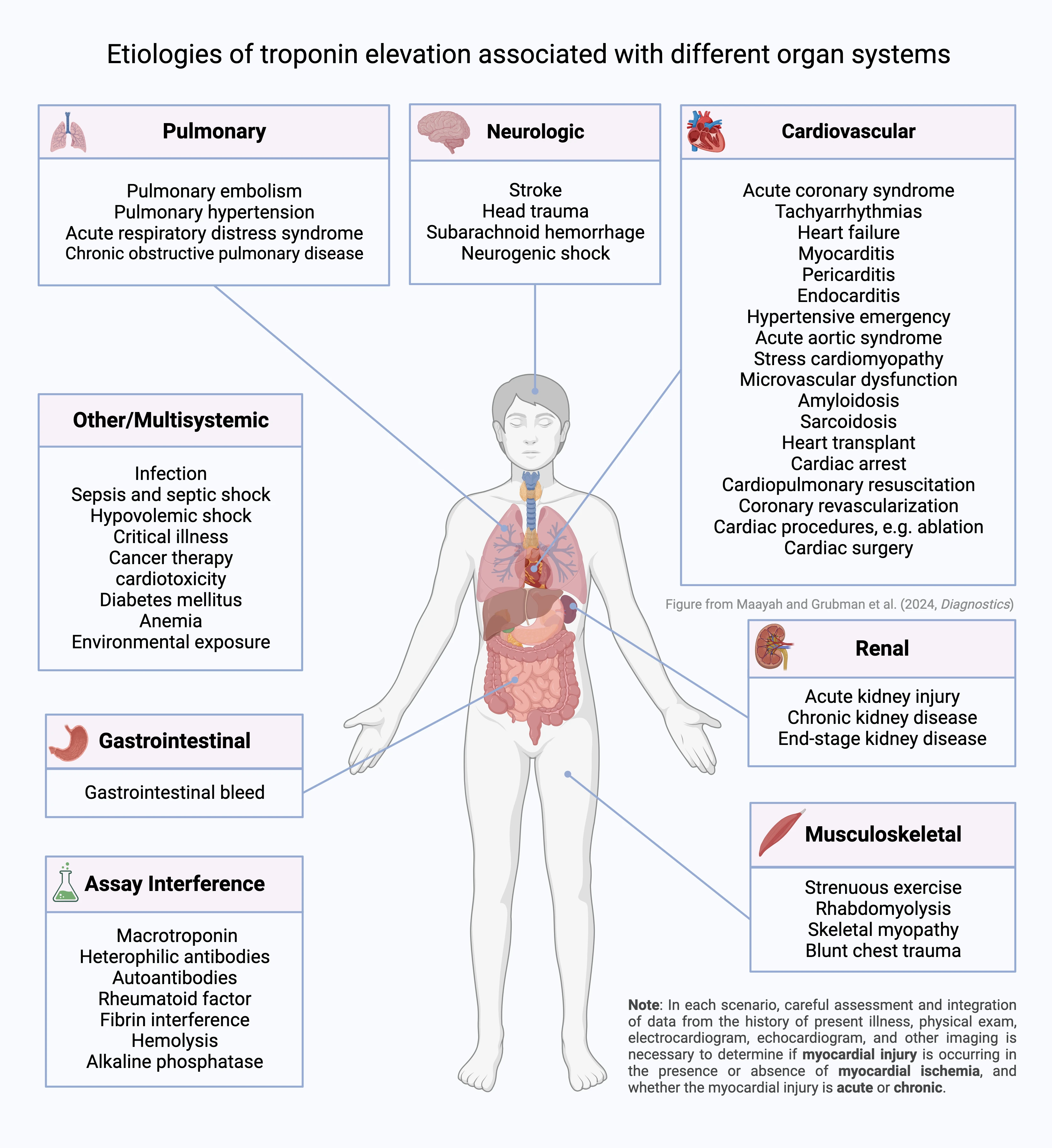
Overview figure: etiologies by organ system
Etiologies of troponin elevation grouped by organ system

Mechanisms of myocardial injury

Ischemia is only one of the ways troponin rises. These are the mechanisms the 5th UDMI recognizes for acute and chronic injury.

Mechanisms of acute myocardial injury

MechanismConditions
Ischemia
  • Myocardial infarction
Inflammation
  • Myocarditis (autoimmune, infectious, toxic)
  • Heart transplant rejection
  • Cytokine-mediated injury in sepsis
Hemodynamic stress
  • Supply–demand imbalance*
  • Tachy- or bradyarrhythmia
  • Acute heart failure
  • Acute pulmonary embolism
  • Malignant hypertension
Physiological stress
  • Strenuous exercise
Catecholamine stress
  • Takotsubo syndrome
  • Subarachnoid hemorrhage
  • Stroke
  • Epileptic seizures
  • Pheochromocytoma
Toxicity
  • Anthracyclines
  • ErbB-targeted therapies
  • Tyrosine kinase inhibitors
  • Immune checkpoint inhibitors
  • Radiation
Trauma
  • Electrical cardioversion
  • Percutaneous coronary or structural intervention
  • Catheter ablation or device implantation
  • Cardiac surgery
  • Cardiac contusion

*Any acute condition that causes oxygen imbalance with reduced supply (hypoxia, anemia, hypotension) and/or increased demand (tachycardia, hypertension).

Mechanisms of chronic myocardial injury

MechanismConditions
Ischemia
  • Chronic coronary syndrome
  • Ischemic cardiomyopathy
Other cardiomyopathies
  • Hypertrophic
  • Hypertensive
  • Dilated
  • Chronic inflammatory
  • Restrictive
  • Infiltrative
  • Uremic cardiomyopathy in chronic kidney disease
Hemodynamic stress
  • Chronic heart failure
  • Systemic hypertension
  • Pulmonary hypertension
Structural
  • Valvular heart disease
  • Congenital heart disease
  • Cardiac tumor

Interference checklist: does this troponin fit?

Not every raised troponin is myocardial injury. Antibody-mediated interference and macrotroponin may account for as many as 1 in 2 elevated troponin I values in asymptomatic populations, so work through these clues when the result does not make sense .

Tick any clue that applies. Nothing ticked yet.

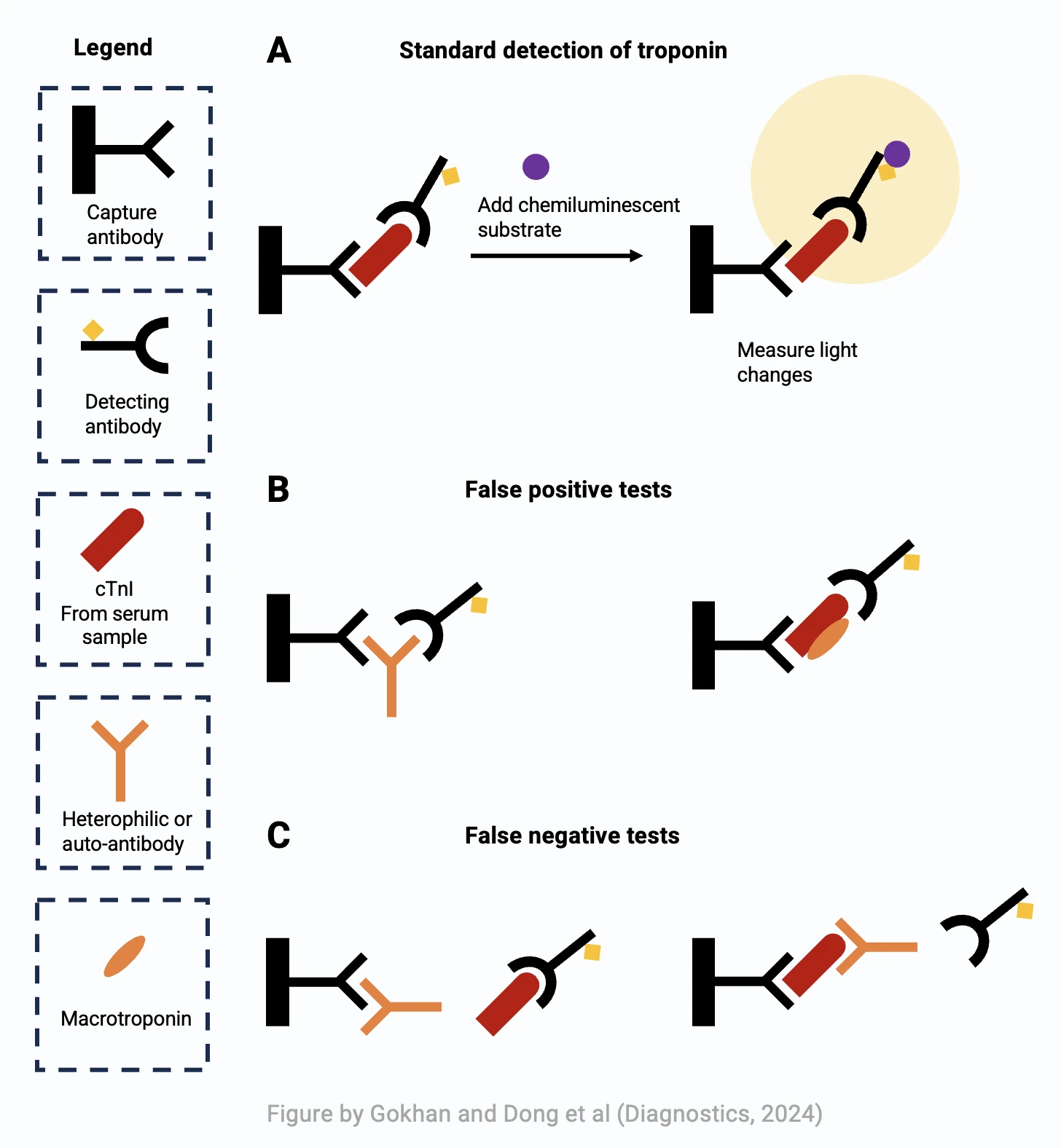
How immunoassay interference works (figure)
Mechanisms of false-positive and false-negative troponin immunoassay results
(A) Standard detection: a capture antibody and a labeled detecting antibody sandwich the troponin. (B) False positives: a heterophilic or auto-antibody bridges the two antibodies with no troponin present (left), or macrotroponin, a troponin-immunoglobulin complex, is measured as troponin (right). (C) False negatives: a heterophilic or auto-antibody blocks the capture antibody (left) or the detecting antibody (right).

Reference

Full citations are available. Please either visit www.troponin.org or the following paper:

Maayah M, Grubman S, Allen S, et al. Clinical Interpretation of Serum Troponin in the Era of High-Sensitivity Testing. Diagnostics (Basel). 2024;14(5):503.

Publisher (DOI)PubMedFree full text (PMC)