
UDMI classifier
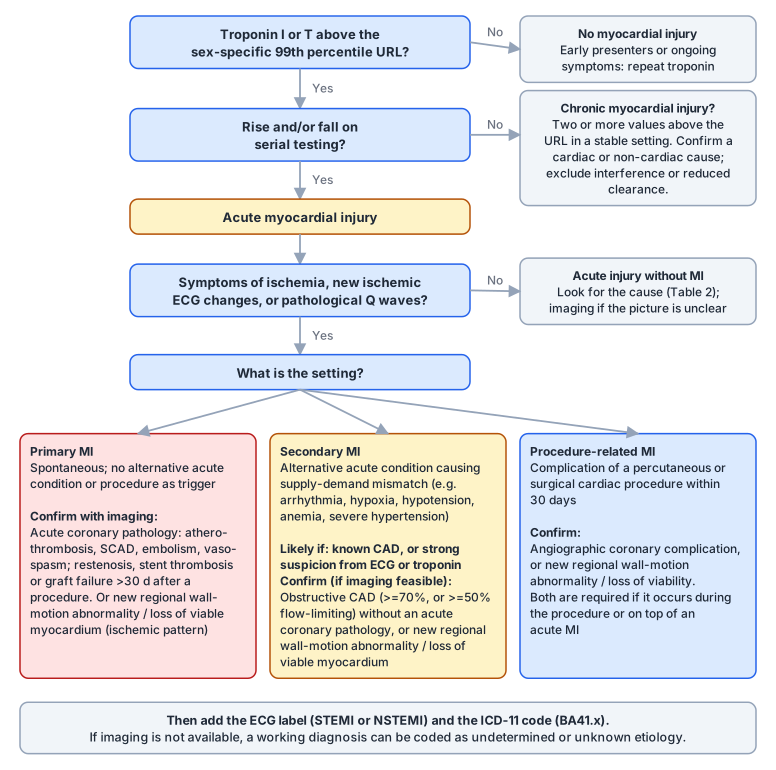
Walk the 5th Universal Definition of MI (2026) pathway: troponin against the sex-specific 99th percentile, acute or chronic injury, ischemic features, clinical setting, then imaging. MI is now primary, secondary, or procedure-related; older sources show a 4th UDMI badge. Inputs are shared with the other tools.
1Troponin
Waiting for inputsA change of 20% or more counts as a rise or fall. Your assay's own delta thresholds are better; use them if they disagree.
- Answer: is any value above the sex-specific 99th percentile URL? Yes or No.
2Evidence of myocardial ischemia
Only needed once troponin shows acute myocardial injury.
3Clinical setting
Only needed for acute injury with ischemic features.
4Coronary and cardiac imaging
Only needed once a setting is chosen for acute injury with ischemic features.
5th UDMI classification
Start with troponin
Answer: is any value above the sex-specific 99th percentile URL? Yes or No.
Needed
- Answer: is any value above the sex-specific 99th percentile URL? Yes or No.
Sources:
An educational walk-through of the definition, not a diagnosis. Clinical judgment, the full history, and local protocols come first.
Not covered by the classifier steps: silent MI and sudden death
Silent or unrecognized MI
Pathological Q waves on a routine ECG in someone with no known MI are not specific on their own. Where possible, confirm unrecognized MI with imaging, preferably cardiac MRI with late gadolinium enhancement. Incidental regional wall-motion abnormalities on echocardiography, or infarcts found on an MRI done for another reason, can also indicate a silent event .
“Silent” can mislead: many patients recall symptoms when asked, but did not think them serious or were not diagnosed at the time. With systematic MRI, unrecognized MI is found in roughly 1 in 5 people over 70 (mostly small infarcts) and in about 3% of asymptomatic middle-aged adults (mean age 50). It is more frequent in chronic coronary syndrome and carries an adverse prognosis, particularly in people without known CAD. The ICD-11 code is BA50.
MI after sudden death
If someone dies suddenly in the community without evaluation, primary MI can be considered. A history of CAD, chest pain before death, or documented ventricular fibrillation without known cardiomyopathy or channelopathy makes it more likely, but without an ECG or post-mortem investigation the diagnosis is uncertain and BA41.Z (unspecified MI) is used. Post-mortem imaging or autopsy is needed to confirm MI and classify it as primary, secondary, or procedure-related .
Type 3 MI no longer exists as a category.
The pathway at a glance
Please discuss specific patient presentation with your local cardiologist. By using this interactive application, you certify that you are a licensed healthcare professional in the United States/Canada or enrolled in a medical training program, and that you will exercise your independent clinical judgment based on patient-specific characteristics prior to applying the knowledge in your clinical practice.