4th UDMI (2018) reference
Kept for learning the older framework and for reading guidelines and studies that still use it.
This page describes the Fourth Universal Definition of MI (2018), which the Fifth (2026) has superseded. It is preserved as it appeared in the original Troponin Toolbox (from ). Its citations are shown as tags: click one to see the reference. The 5th UDMI no longer uses types 1–5.
The meaning of the term “myocardial infarction” (MI) varied widely until the World Health Organization first began to standardize heart disease nomenclature in the 1950s–1970s, largely using electrocardiogram (ECG)-based criteria . Over the next several decades, joint task forces from the American College of Cardiology, American Heart Association, European Society of Cardiology, and World Heart Federation issued four successive iterations of the Universal Definition of Myocardial Infarction (UDMI) Consensus Document. As cardiac biomarker assays improved, the first UDMI in 2000 adopted the concept of using biomarkers such as serum troponin T and I (TnT/I) as a core component in the diagnosis of MI . The second UDMI in 2007 introduced the five categories of MI and introduced the concept of troponin (Tn) rise and/or fall with at least one value above the 99th percentile upper reference limit (URL) . The third UDMI in 2012 added criteria for the diagnosis of MI in the setting of left bundle branch block and paced rhythms and introduced an emphasis on incorporating imaging findings and the clinical presentation into the interpretation of Tn elevations . The fourth and most recent UDMI published in 2018 issued updated definitions to accommodate the increased use of hs-Tn, discussed the implications of chronic elevations in Tn, and further clarified distinctions between the separate yet interrelated entities of myocardial injury, myocardial ischemia, and myocardial infarction .
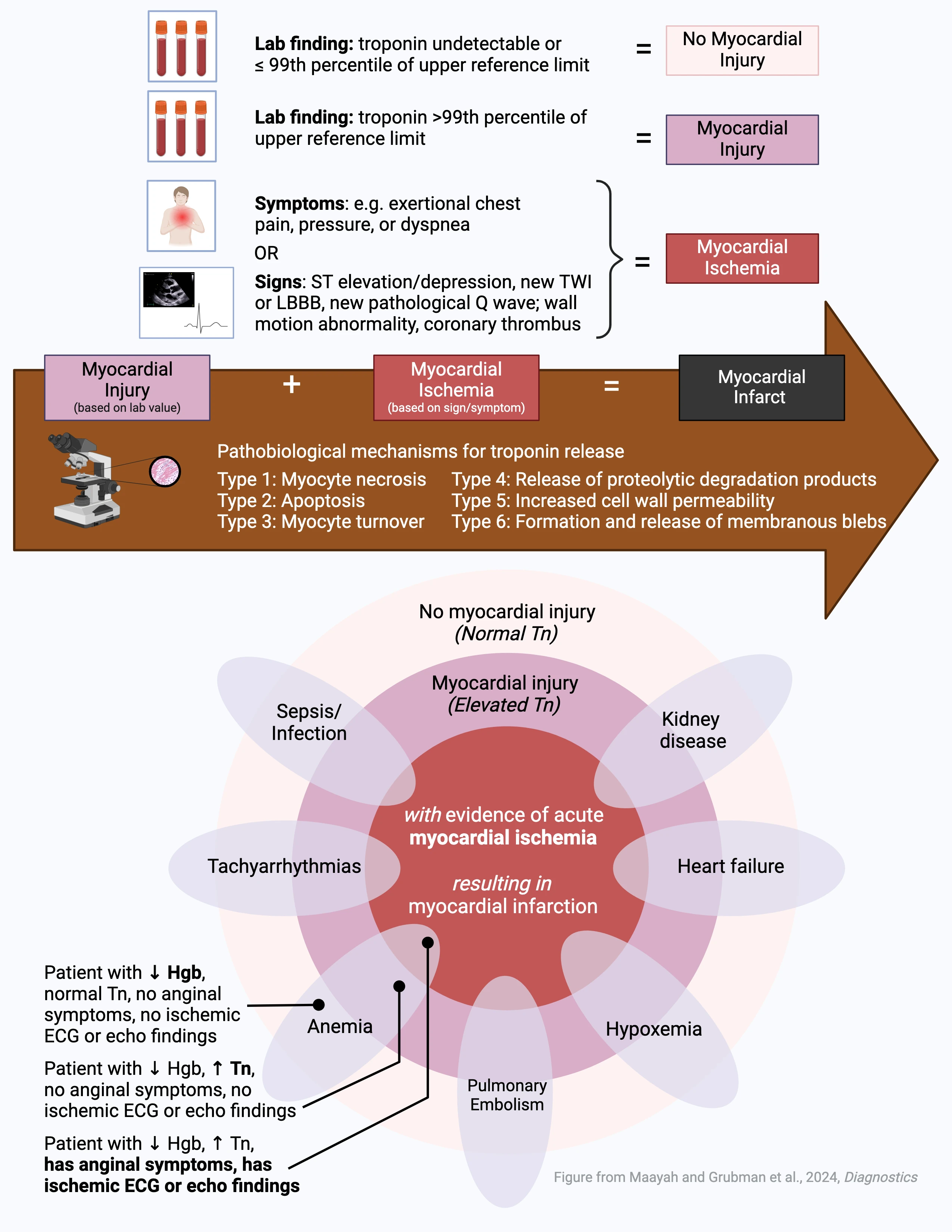
For example, a patient with a drop in hemoglobin, normal Tn, and no anginal symptoms, ischemic ECG changes, or echo findings, has no myocardial injury. A patient with a drop in hemoglobin, elevation in Tn, but no anginal symptoms, ischemic changes, or echo findings, has myocardial injury without myocardial ischemia. Whereas a patient with a drop in hemoglobin, elevation in Tn, and either anginal symptoms, ischemic changes, or echo findings, has myocardial injury with myocardial ischemia, resulting in myocardial infarction.
Reference
Full citations are available. Please either visit www.troponin.org or the following paper:
Maayah M, Grubman S, Allen S, et al. Clinical Interpretation of Serum Troponin in the Era of High-Sensitivity Testing. Diagnostics (Basel). 2024;14(5):503.