4th → 5th UDMI crosswalk and ICD-11 codes
Translate older MI types into the 5th UDMI classification, and look up the matching ICD-11 codes.
Why you need this
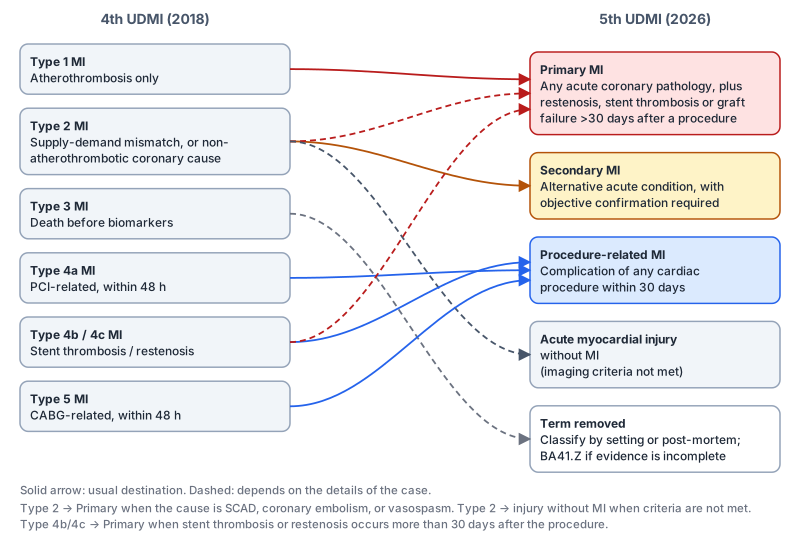
The 5th UDMI (2026) replaced types 1–5 with primary, secondary, and procedure-related MI. Most guidelines, trials, charts, and coding still use the 4th UDMI , including the 2025 ACC/AHA ACS guideline , which defines its scope by type 1 MI. The mapping is not always one-to-one, so read the “In practice” line on each row.
Term by term
4th UDMI (2018)
Type 1 MI
Acute atherothrombosis (plaque rupture or erosion); STEMI or NSTEMI.
5th UDMI (2026)
Primary MIMaps directly
Any acute coronary pathology: atherothrombosis, spontaneous coronary artery dissection (SCAD), coronary embolism, vasospasm; plus restenosis, stent thrombosis, or graft failure more than 30 days after a procedure.
In practice: Broader than type 1. Every type 1 MI is a primary MI, but not every primary MI is atherothrombotic.
4th UDMI (2018)
Type 2 MI
Supply–demand imbalance from an acute coronary pathology other than atherothrombosis, or from an alternative acute condition, with or without CAD.
5th UDMI (2026)
Secondary MI, primary MI, or injury without MISplits by details
Secondary MI: alternative acute condition with objective confirmation (obstructive CAD without an acute coronary pathology, or a new regional wall-motion abnormality / loss of viable myocardium). SCAD, coronary embolism, and vasospasm move to primary MI. If confirming features are absent, the label is acute myocardial injury.
In practice: Expect fewer secondary MI diagnoses than type 2 MI diagnoses. A positive troponin in a sick patient is no longer enough.
4th UDMI (2018)
Type 3 MI
Cardiac death with symptoms or ECG changes of ischemia, before biomarkers could be drawn or rise.
5th UDMI (2026)
Term removedRemoved
Where MI is the likely cause of death, classify it as primary, secondary, or procedure-related from the clinical setting or post-mortem findings. With incomplete evidence, code unspecified MI (BA41.Z).
In practice: There is no direct successor category.
4th UDMI (2018)
Type 4a MI
PCI-related MI within 48 hours: troponin >5× the 99th percentile plus ischemia, new loss of viable myocardium, or a procedural complication on angiography.
5th UDMI (2026)
Procedure-related MIMaps directly
A coronary complication of any percutaneous or surgical cardiac procedure within 30 days, with acute myocardial injury and confirming imaging features. No fixed multiple of the 99th percentile is required.
In practice: The window widens from 48 hours to 30 days. Large post-procedural rises are only a likelihood indicator (for example, >5× at 6 h after intervention).
4th UDMI (2018)
Type 4b MI
MI caused by stent thrombosis (early or late).
5th UDMI (2026)
Procedure-related MI (≤30 days) or primary MI (>30 days)Splits by details
Stent thrombosis more than 30 days after the procedure is coded as primary MI (BA41._6). Within 30 days it is a procedural complication.
In practice: Late stent thrombosis is now treated as de novo coronary disease, not a procedural complication.
4th UDMI (2018)
Type 4c MI
MI caused by in-stent restenosis.
5th UDMI (2026)
Procedure-related MI (≤30 days) or primary MI (>30 days)Splits by details
Restenosis more than 30 days after the procedure is coded as primary MI (BA41._5). Early restenosis or recoil within 30 days is a procedural complication.
In practice: Same rule as 4b.
4th UDMI (2018)
Type 5 MI
CABG-related MI within 48 hours: troponin >10× the 99th percentile plus new Q waves, new loss of viable myocardium, or graft occlusion.
5th UDMI (2026)
Procedure-related MIMaps directly
Same criteria as for percutaneous procedures (for example, bypass graft failure or coronary impingement), within 30 days.
In practice: One set of criteria for surgery and PCI, so outcomes of the two approaches can be compared.
4th UDMI (2018)
MINOCA (MI with non-obstructive coronary arteries)
A presumed infarction with no stenosis ≥50% on angiography.
5th UDMI (2026)
MINOCA: myocardial injury with non-obstructive coronary arteriesRenamed
Renamed to a working diagnosis. Intravascular imaging, invasive functional testing, and cardiac MRI (ideally within 2 weeks) are used to find the real cause, which is often myocarditis or Takotsubo syndrome.
In practice: The final diagnosis is whatever the work-up finds. MI is the answer in about a quarter of those who get cardiac MRI.
4th UDMI (2018)
“Typical” and “atypical” chest pain
Common descriptors of symptom quality.
5th UDMI (2026)
“Chest discomfort”; typical/atypical discouragedRenamed
Symptoms labeled atypical are more common in women being evaluated for MI, and the label can contribute to diagnostic delay. Describe the actual symptoms, and ask about associated symptoms.
In practice: The Fanaroff data used on the Bayes interpreter page still use the word “typical”.
ICD-11 codes (Table 4)
The code is BA41.0 (STEMI) or BA41.1 (NSTEMI), plus a sixth-digit stem for the mechanism. Unstable angina, unspecified MI, and unrecognized MI have their own codes .
27 of 27 codes
| Code | Meaning | Category |
|---|---|---|
| BA41.01 | STEMI, primary MI: atherothrombosis | Primary MI |
| BA41.02 | STEMI, primary MI: spontaneous coronary artery dissection | Primary MI |
| BA41.03 | STEMI, primary MI: coronary embolism | Primary MI |
| BA41.04 | STEMI, primary MI: coronary vasospasm | Primary MI |
| BA41.05 | STEMI, primary MI: restenosis >30 days from procedure | Primary MI |
| BA41.06 | STEMI, primary MI: stent thrombosis >30 days from procedure | Primary MI |
| BA41.07 | STEMI, primary MI: graft failure >30 days from procedure | Primary MI |
| BA41.08 | STEMI, primary MI: undetermined etiology | Primary MI |
| BA41.09 | STEMI, primary MI: unknown etiology (no coronary imaging) | Primary MI |
| BA41.0A | STEMI, secondary MI: alternative acute condition (add the code for that condition) | Secondary MI |
| BA41.0B | STEMI, procedure-related MI: complication of a percutaneous cardiac procedure within 30 days | Procedure-related MI |
| BA41.0C | STEMI, procedure-related MI: complication of an open cardiac surgical procedure within 30 days | Procedure-related MI |
| BA41.11 | NSTEMI, primary MI: atherothrombosis | Primary MI |
| BA41.12 | NSTEMI, primary MI: spontaneous coronary artery dissection | Primary MI |
| BA41.13 | NSTEMI, primary MI: coronary embolism | Primary MI |
| BA41.14 | NSTEMI, primary MI: coronary vasospasm | Primary MI |
| BA41.15 | NSTEMI, primary MI: restenosis >30 days from procedure | Primary MI |
| BA41.16 | NSTEMI, primary MI: stent thrombosis >30 days from procedure | Primary MI |
| BA41.17 | NSTEMI, primary MI: graft failure >30 days from procedure | Primary MI |
| BA41.18 | NSTEMI, primary MI: undetermined etiology | Primary MI |
| BA41.19 | NSTEMI, primary MI: unknown etiology (no coronary imaging) | Primary MI |
| BA41.1A | NSTEMI, secondary MI: alternative acute condition (add the code for that condition) | Secondary MI |
| BA41.1B | NSTEMI, procedure-related MI: complication of a percutaneous cardiac procedure within 30 days | Procedure-related MI |
| BA41.1C | NSTEMI, procedure-related MI: complication of an open cardiac surgical procedure within 30 days | Procedure-related MI |
| BA40 | Unstable angina | Other |
| BA41.Z | Unspecified myocardial infarction (for example, sudden death without evaluation) | Other |
| BA50 | Unrecognized myocardial infarction | Other |
BA41.0x is the STEMI form and BA41.1x the NSTEMI form of each stem, as printed in Table 4 of the 5th UDMI. Check your institution's current ICD-11 release before coding.