Terminology: the 5th Universal Definition of MI
The default framework on this site is the 5th UDMI (2026). Older terms appear only where a guideline or study used them.
The Fifth Universal Definition of Myocardial Infarction (2026) is a joint statement of the ESC, ACC, AHA, and World Heart Federation . It keeps the core idea of the 4th UDMI, that MI means acute myocardial injury plus evidence of ischemia, but changes how infarction is classified and how firmly it must be confirmed.
The changes that matter most
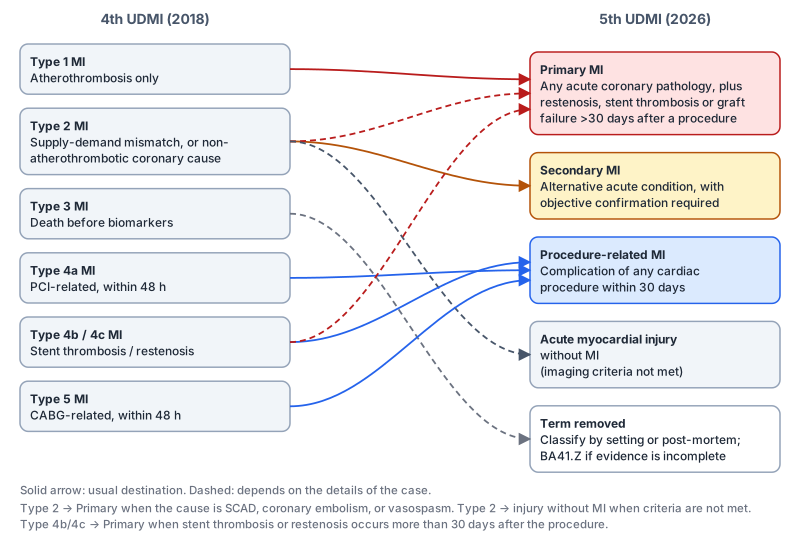
- Clinical categories replace numbered types. Primary, secondary, and procedure-related MI replace types 1, 2, 3, 4a–c, and 5 .
- Primary MI is broader than type 1. It covers every acute coronary pathology (atherothrombosis, spontaneous coronary artery dissection, coronary embolism, vasospasm) and also restenosis, stent thrombosis, or graft failure more than 30 days after a procedure . The goal is to avoid missing a real coronary event and to prompt angiography and imaging to find the mechanism.
- Secondary MI is narrower and needs objective confirmation. The non-atherothrombotic coronary causes that used to sit in type 2 now belong to primary MI. For the rest, confirmation requires obstructive coronary disease without an acute coronary pathology, or a new regional wall-motion abnormality or loss of viable myocardium . Expect fewer secondary MI diagnoses than type 2 diagnoses.
- Procedure-related MI has one set of criteria. It applies to any percutaneous or surgical cardiac procedure, within 30 days instead of 48 hours, and drops the old fixed 5× and 10× troponin multiples .
- Type 3 is removed. When MI is the likely cause of death, the case is classified by clinical setting or post-mortem findings .
Other changes
- Sex-specific 99th percentile limits are written into the definition of acute myocardial injury .
- MINOCA is now myocardial injury with non-obstructive coronary arteries, a working diagnosis rather than a final one .
- Symptoms: “chest discomfort” is preferred, and “typical” versus “atypical” is discouraged .
- Objective criteria are given for silent (unrecognized) MI and for MI after sudden death .
- ICD-11 codes now map to the new categories, including a code for unspecified MI (BA41.Z) .
- STEMI and NSTEMI remain, as ECG-based working labels used for triage.
Why the change
The numbered types were hard to apply consistently. Putting SCAD, embolism, and vasospasm in the same group as ordinary supply–demand imbalance mixed conditions with very different work-ups and treatments, and many type 2 diagnoses were made on symptoms alone, with no consequence for care. Troponin multiples after procedures were arbitrary: in a large prospective cohort, 97.5% of cardiac surgery patients exceeded 10× the 99th percentile, and thresholds above roughly 218× were needed to identify patients at higher risk of peri-procedural death .
If you are translating between old and new terms, use the crosswalk.
Reference
Full citations are available. Please either visit www.troponin.org or the following paper:
Maayah M, Grubman S, Allen S, et al. Clinical Interpretation of Serum Troponin in the Era of High-Sensitivity Testing. Diagnostics (Basel). 2024;14(5):503.