Troponin biochemistry: from sarcomere to assay
What troponin is, how it reaches the blood, how assays measure it, and what can make a number wrong. Adapted and updated from the companion review by .
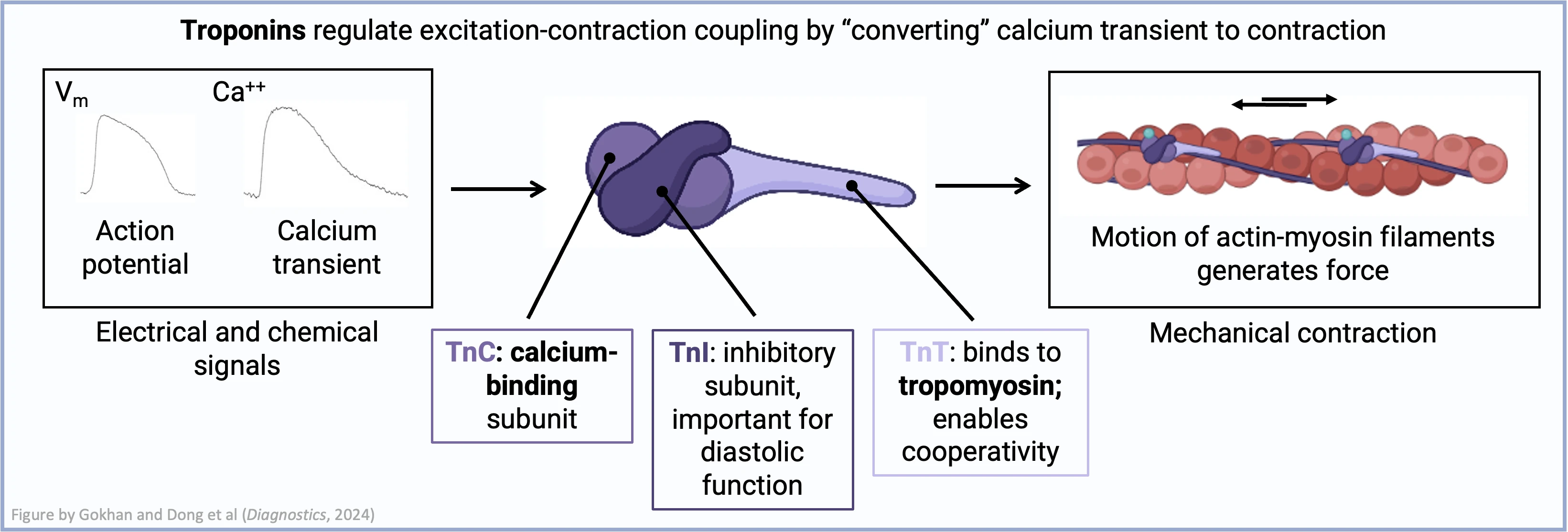
Troponin is a three-part protein complex that sits on the thin (actin) filament of striated muscle, together with tropomyosin. It is the switch that links calcium to contraction. It is also ancient: it is conserved across species, which is part of why it works as a reliable marker .
Three subunits, three jobs
| Subunit | Role |
|---|---|
| Troponin C (TnC) | Binds calcium. When calcium rises, TnC changes shape and releases the brake that TnI places on actin. |
| Troponin I (TnI) | The inhibitory subunit. At low calcium it blocks the interaction between actin and myosin, so the muscle relaxes. |
| Troponin T (TnT) | The anchor. It ties the complex to tropomyosin and makes the response cooperative along the filament. |
Contraction follows the sliding filament model: myosin pulls on actin, and tropomyosin normally blocks that interaction until calcium arrives. By sitting between calcium and tropomyosin, troponin is well placed to control the whole process .
Why we measure I or T, not C
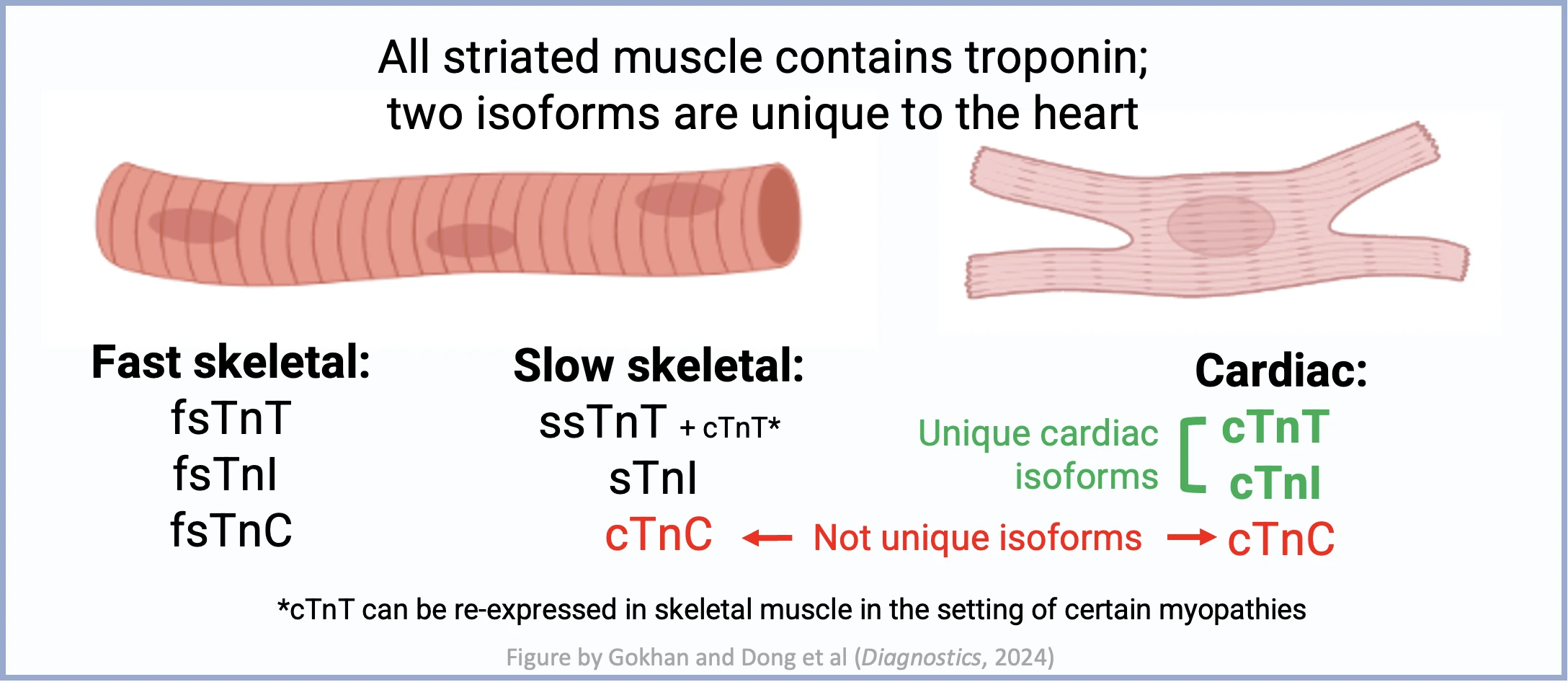
Each subunit comes in versions (isoforms) encoded by different genes, and which ones are specific to the heart decides what can be used as a test .
- TnC has only two forms in humans, and the form in the heart is identical to the one in slow-twitch skeletal muscle. A TnC test could not tell heart from skeletal muscle, so no clinical assay uses it.
- TnI has separate genes for slow skeletal, fast skeletal, and cardiac muscle. Cardiac TnI is made only in the heart, which makes it highly specific. The fetal heart makes the slow skeletal form, but by about nine months of life only the cardiac form is found.
- TnT also has separate genes for slow skeletal, fast skeletal, and cardiac muscle. Cardiac TnT is specific to the heart in health, but damaged or regenerating skeletal muscle can re-express it. That is why TnT can rise in myopathies and rhabdomyolysis, and why troponin T needs extra care in someone with muscle disease (see the etiologies page).
A few details that explain clinical behavior
- TnI has sites where protein kinase A adds phosphate during adrenergic stimulation. This lowers its calcium sensitivity and speeds relaxation, so TnI acts as a regulator of relaxation (lusitropy) while TnC regulates contractility .
- TnC is the target of the drug levosimendan, which makes it more sensitive to calcium .
- In heart failure, the fraction of phosphorylated TnI falls. The significance is still debated .